Project Overview
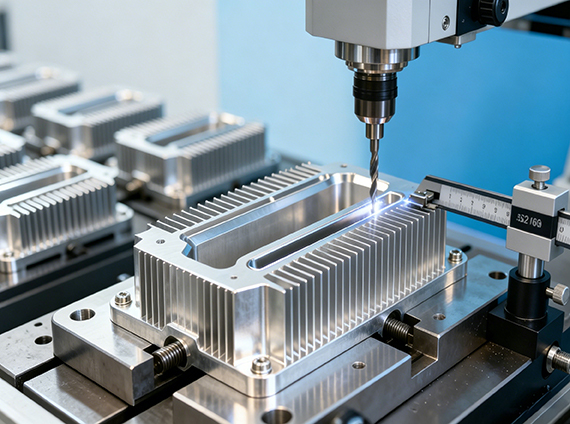
This case details our precision machining solution for heat dissipation and sealing accessories used in new energy equipment. The project utilizes 5052 and 6063 aluminum alloys, materials chosen for their excellent thermal conductivity and formability, to meet the client’s strict requirements for high-efficiency thermal management, structural stability, and leak-proof sealing reliability. Our goal was to overcome multiple machining challenges to deliver high-performance parts that support the client’s large-scale mass production for new energy applications.
Core Challenges & Our Solutions
1. Ultra-Thin Fin Machining for High Thermal Efficiency
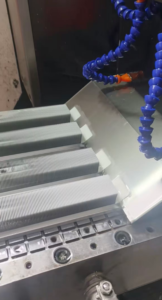
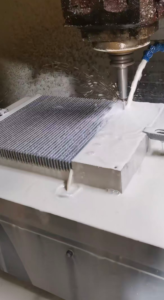
The primary challenge was machining ultra-thin, high-density heat dissipation fins. These delicate structures are critical for maximizing heat transfer but are extremely prone to bending, vibration, and deformation during conventional CNC milling, leading to inconsistent thickness, reduced heat dissipation performance, and even scrapped parts.
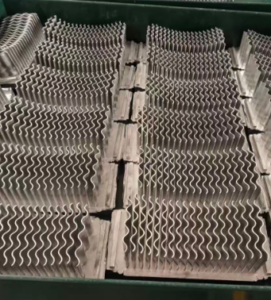
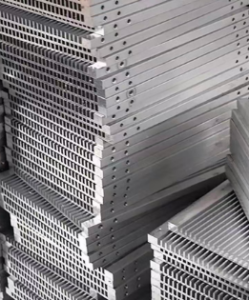
To address this, we leveraged our dedicated fin skiving machine (skiving equipment for heat sinks) — specialized equipment purpose-built for forming ultra-thin fins. This process uses controlled, high-precision skiving to form fins directly from a solid aluminum base, creating a monolithic structure with no contact resistance. The skiving process ensures consistent fin thickness, height, and spacing, even for ultra-thin profiles, while eliminating the vibration and deformation risks common with traditional milling. This solution delivered the high thermal efficiency the client required, with perfectly formed, uniform fins that maintained their structural integrity.
2. Deep Cavity Machining for Complex Internal Structures
The parts feature complex deep cavities essential for fluid channels and heat exchange. Machining these cavities presents significant challenges, including poor chip evacuation, insufficient coolant penetration, and tool deflection, which can lead to surface roughness, dimensional errors, and tool breakage.
Our solution involved using high-performance, long-reach tools with specialized coatings designed for deep cavity applications. We implemented a high-pressure through-spindle coolant system to flush chips away effectively and reduce heat buildup. We also adjusted the machining sequence to start with roughing and then proceed to semi-finishing and finishing passes, reducing tool load and ensuring the final cavity dimensions were accurate and smooth.
3. High Flatness Machining of Sealing Grooves
The sealing grooves required extremely high flatness to ensure a reliable, leak-proof seal. Even minor surface irregularities or distortion in these grooves can lead to seal failure, which is a critical risk in new energy systems. Achieving the required flatness on these precision surfaces is a major hurdle, as residual stresses from machining can easily cause warping.
We tackled this by first performing a stress-relieving process on the raw material to minimize potential warping. Then, we used a two-step machining process: a roughing pass to remove the bulk material, followed by a finishing pass with a high-feed, low-force strategy. This minimized the introduction of new stresses. Finally, we performed a precision lapping process on the sealing surfaces to achieve the required flatness and surface finish, ensuring a perfect seal.
Project Outcome
Our comprehensive solutions delivered exceptional results for the client:
- Reliable Sealing: The high-precision sealing grooves met the strict flatness requirements, ensuring zero leaks in the final assembly.
- Perfectly Formed Ultra-Thin Fins: Our fin skiving machine produced high-density, uniform fins with no bending or deformation, meeting the client’s thermal efficiency targets.
- No Structural Deformation: The parts maintained their structural integrity throughout the machining process, with no warping of the thin fins or complex cavities.
- Mass Production Support: The optimized process proved highly stable and repeatable, enabling us to support the client’s large-scale production needs with consistent quality and on-time delivery.
This project demonstrates our deep expertise in solving complex machining problems for the new energy sector, leveraging specialized equipment like our fin skiving machine to deliver high-performance, reliable parts that meet the most demanding specifications.