Project Overview
Core Processing Challenges & Targeted Solutions
1. Mirror High-Gloss Surface Without Scratches or Tool Marks
3C consumer electronics require flawless mirror glossy surfaces for exterior parts. Conventional CNC machining will leave obvious tool lines, scratches and uneven texture; manual polishing will easily cause edge collapse, dimensional shrinkage and inconsistent gloss, failing high-end appearance standards.
Our Solution: We match ultra-fine grain diamond cutting tools, optimize high-speed low-feed CNC finishing parameters to eliminate tool marks on the surface. After CNC forming, we adopt full-process vibration buffing and precision mechanical polishing instead of manual treatment, strictly control polishing pressure and time to avoid dimensional loss. Finally, we carry out fine pre-treatment for anodizing to achieve uniform mirror high-gloss finish that fully meets the client’s visual inspection standard.
2. Thin-Walled Part Anti-Deformation Control
3C structural parts mostly feature ultra-thin wall structures to pursue lightweight design. 6061 & 7075 aluminum will generate internal cutting stress during removal of large material allowance, which easily leads to bending, warping and dimensional distortion after processing, resulting in batch scrapping.
Our Solution: We add a complete stress relief procedure before formal machining. The raw aluminum material undergoes aging treatment to release internal forging stress first. In CNC processing, we adopt layered symmetrical cutting to balance material removal force, and design customized vacuum absorption fixtures with uniform support to avoid local stress concentration. We also separate roughing and finishing by cooling interval, letting the workpiece fully release cutting heat and stress, fundamentally solving thin-wall deformation issues.
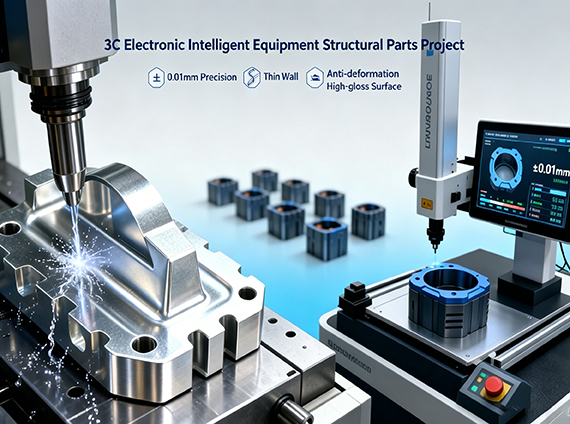
3. Ultra-Precision Hole Position Tolerance ±0.01mm
Mounting and positioning holes of intelligent equipment demand extremely high position accuracy; tiny deviation beyond ±0.01mm will lead to assembly jamming and functional failure. Thin-wall vibration, tool deflection and repeated clamping offset are the main factors causing hole position errors.
Our Solution: We deploy high-rigidity 5-axis CNC machining centers to complete all hole machining in one single clamping setup, eliminating position deviation caused by repeated re-fixturing. We use solid carbide lengthened drills with anti-deflection design, and implement segmented drilling parameters to reduce tool shaking. After drilling, we add a precision reaming process to lock hole position and aperture tolerance strictly within ±0.01mm, matching high-precision assembly requirements of 3C electronic equipment.
Project Outcome
- Perfect mirror high-gloss surface finish without tool marks, scratches or edge collapse, passing the client’s strict appearance inspection.
- Full control of thin-wall deformation, all finished parts maintain stable dimensional consistency without warpage or bending.
- All positioning holes achieve ±0.01mm ultra-precise tolerance, smooth assembly without interference.
- The whole optimized processing flow achieves a stable production yield rate ≥99.9%, supporting continuous large-volume orders for leading 3C electronic enterprises.
- Reliable stable mass production capacity and consistent quality won long-term repeat cooperation with the client, becoming their fixed precision parts supplier.
Industry Strength Highlight